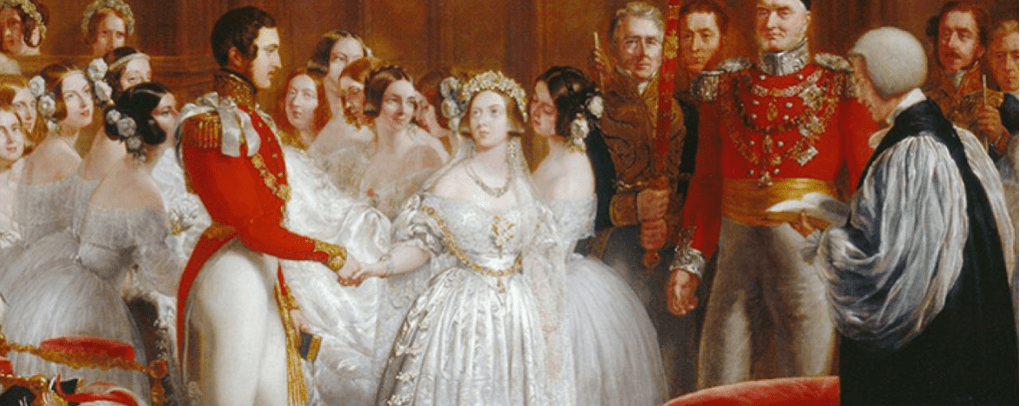
“At about ½ p. 12, I sent for Albert, who came to the Closet, where I was alone, & after few minutes I said, I thought he must be aware why I wished him & his brother to come here, & that it would make me too happy if he would consent to what I wanted (that he should marry me). We embraced each other over & over again & he was so kind & so affectionate. To feel I am loved by such an angel as Albert, is too great a happiness to describe, & really I felt it was the happiest & brightest moment in my life, which made up for all I had suffered & endured.”
So read Queen Victoria’s diary entry on 15th October, 1839. Her position as queen meant that the proposal came from her, rather than Prince Albert, her now fiancé and also first cousin. Their families were incredibly pleased with the news – Victoria’s mother and their uncle, Leopold, had been planning for this match since the bride and groom were babies.
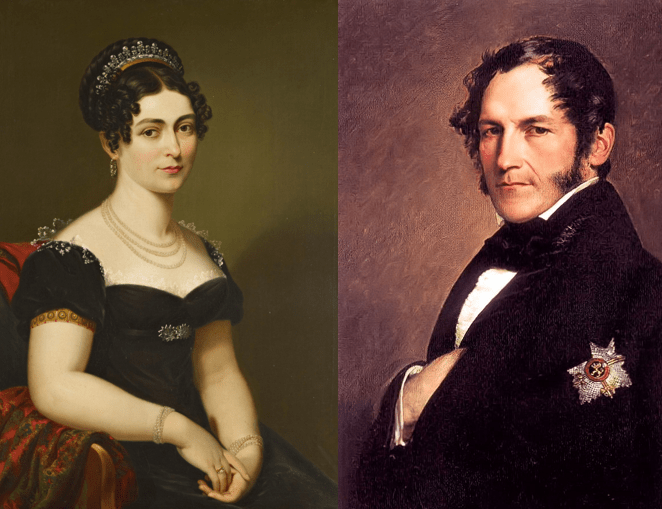
Victoire, Duchess of Kent, and her brother, Leopold, King of the Belgians
Despite being cheered by the public following her ascension, the scandal of the ‘Flora Hastings Affair’ had severely damaged the young queen, and she was actually hissed and booed should she venture outside of Buckingham Palace. So, Lord Melbourne, her prime minister, was keen for the marriage to take place quickly, and use it as an opportunity to bolster Victoria’s popularity. The date was set for 10th February, 1840, and the ceremony was to be held in the Chapel Royal at St James’s Palace.
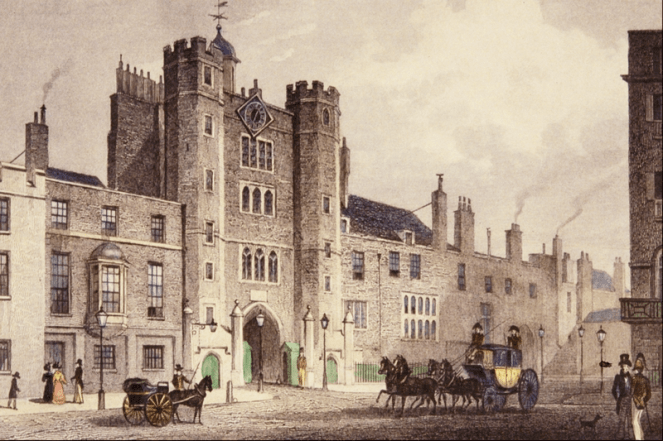
Chapel Royal St James’s Palace
There was a carriage procession to the ceremony – Albert travelling with his father, the Duke of Saxe-Coburg and Gotha, and brother, Ernst, and Victoria, with her mother, the Duchess of Kent, and the Duchess of Sutherland (her Mistress of the Robes).
Victoria famously wore a white dress for the ceremony, determined to be seen as a bride and wife, rather than queen. It was made of Spitalfields silk and decorated with a Honiton lace flounce – both chosen in a deliberate effort to boost British industry. The dress was created by Mary Bettans of Jermyn Street, and the lace designed by William Dyce, Head of the Government School of Design. Her veil was also Honiton lace, and a wreath of orange blossoms was chosen over a crown. Her bridal bouquet was made entirely of snowdrops – sadly the story of her carrying a sprig of myrtle appears to be untrue, and the tradition actually started with her eldest daughter, Vicky, The Princess Royal. It is from her bouquet that the myrtle bushes at Osbourne House now grow.
On her feet, Queen Victoria wore white satin slippers made by Gundry & Sons of Soho Square, the Queen’s shoemaker from 1824 to 1898.
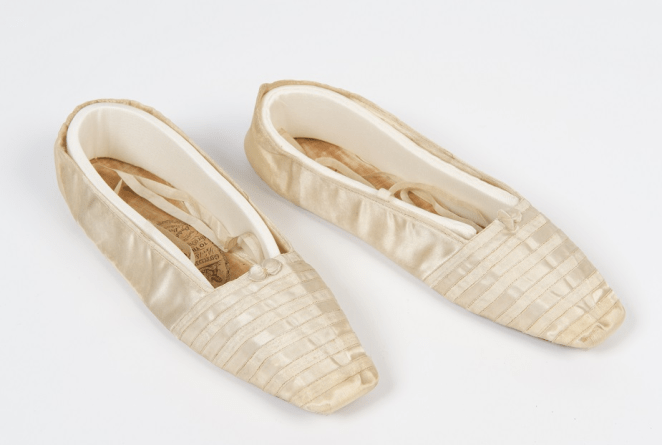
© Northampton Museum and Art Gallery
She wore a diamond necklace and earrings, made by Rundell and Bridge, and gifted to her by the Sultan of Turkey. As her ‘something blue’, she added a sapphire cluster brooch to her outfit, which was made by Garrard, and had been designed and gifted by Albert.

She later described her outfit in her diary entry:
“I wore a white satin dress, with a deep flounce of Honiton lace, an imitation of an old design. My jewels were my Turkish diamond necklace & earrings & dear Albert’s beautiful sapphire branch.”
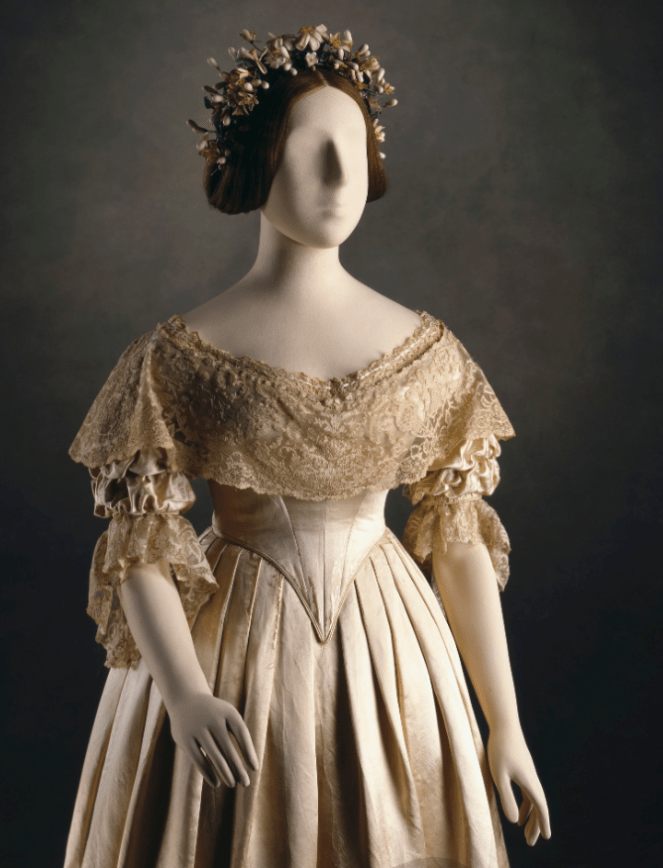
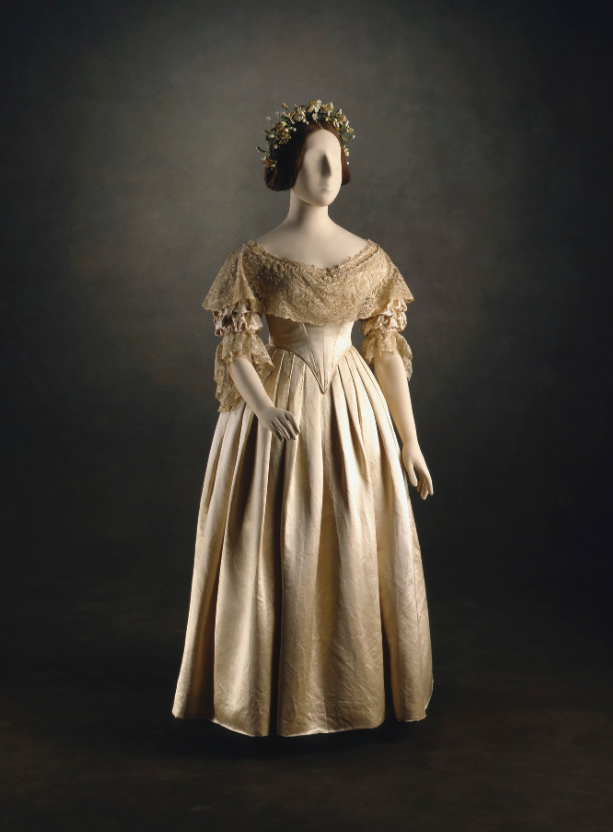
The Royal Collection Trust © His Majesty King Charles III 2024
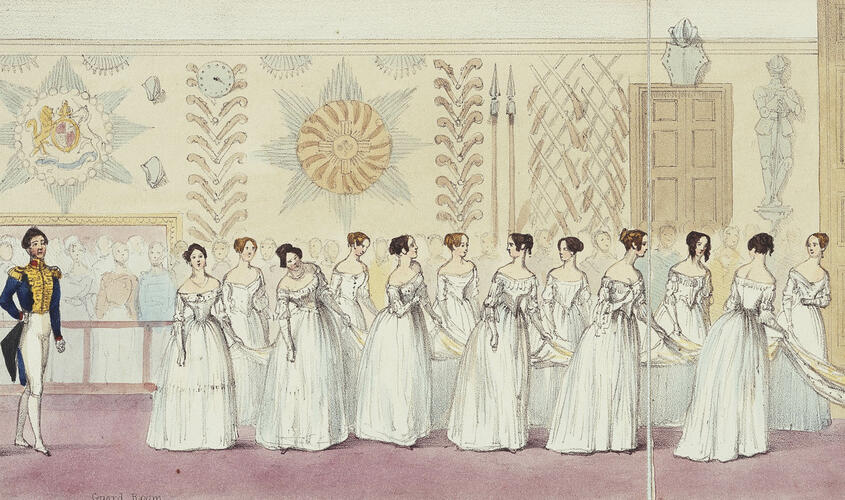
Her dress had a satin court train, 18 foot long, which was carried by her 12 attendants. All the eldest daughters of peers, Albert had initially wanted them selected based on their reputations, claiming all should be born of a mother of ‘spotless character’. However, this was no easy feat in a court that had, until recently, been led by the morals of Victoria’s Hanoverian uncles. Indeed, one of the bridesmaids chosen – Lady Ida Harriet Augusta Hay – was the granddaughter of William IV and his long-term mistress, Dorothea Jordan.
Victoria designed the attendants dresses herself– simple gowns of white silk, trimmed with white roses on the skirt and boddice, and also their hair.
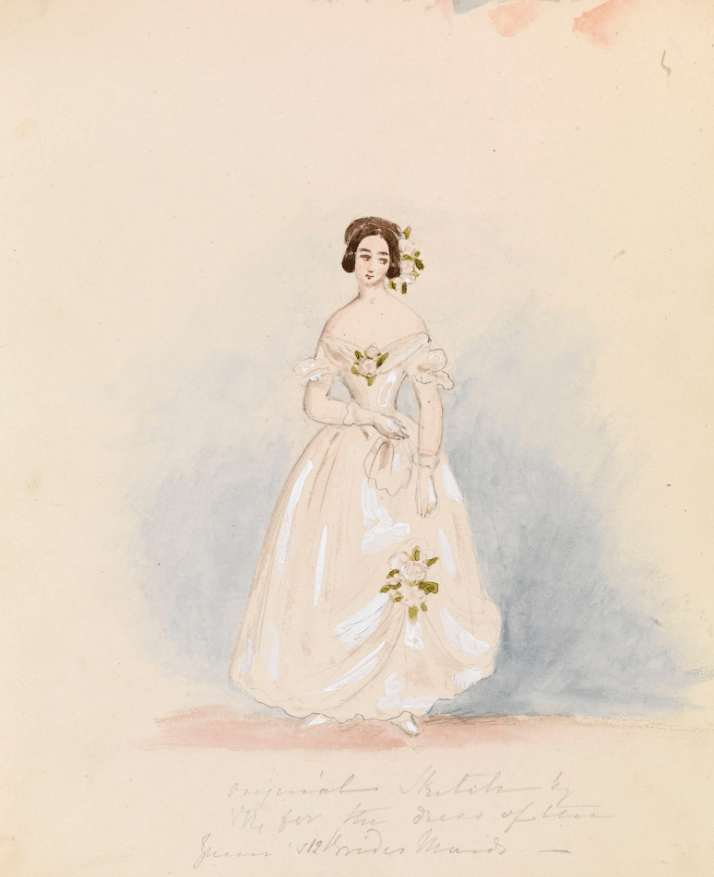
Watercolour design for her bridesmaids dresses, by Queen Victoria. © His Majesty King Charles III 2024
At midday, to a fanfare of trumpets, the bride’s procession began. Victoria entered the Chapel Royal to the strains of Handel’s ‘Virtuous Wife’, and was supported by her uncle, the Duke of Sussex, in place of her deceased father. There were rather too many attendants for the length of her train, so they were forced to take short, shuffling steps so as not to trip over each other.
The Royal Collection Trust © His Majesty King Charles III 2024
Albert was waiting for her, seated at the left hand of the altar, in the scarlet and white uniform of a British Field Marshall. He had entered ahead of Victoria, to the sound of Handel’s ‘Hail the Conquering Hero Comes’.
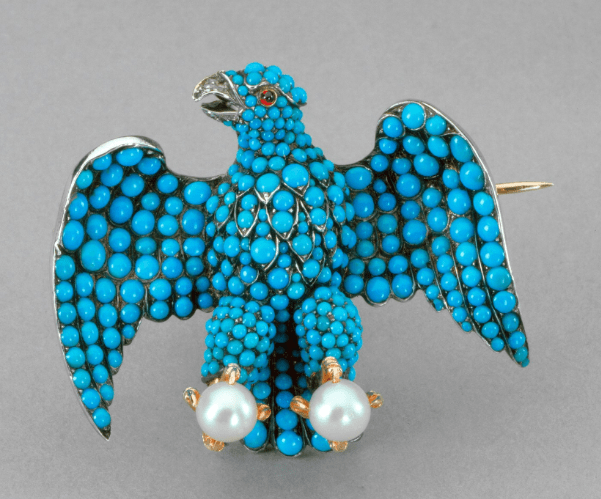
After the register was signed in the throne room, Victoria presented her 12 attendants with a gift in a blue velvet box – an eagle-shaped brooch of turquoise and pearls, designed by Prince Albert himself. The eagle had a ruby eye and a diamond beak, and was created by London jeweller, Charles du Vé. The stones chosen were symbolic for the occasion: turquoises and pearls representing true love, rubies for passion, and diamonds for eternity.
The Royal Collection Trust © His Majesty King Charles III 2024
When they eventually emerged from the Chapel Royal, St James’s Palace, Victoria was met with loud cheers and applause from crowds, who had waited to see their newly-wed queen, despite the wind and rain. Carriages took the bridal party and invited guests back to Buckingham Palace, where a wedding breakfast awaited them.
The Royal Collection Trust © His Majesty King Charles III 2024
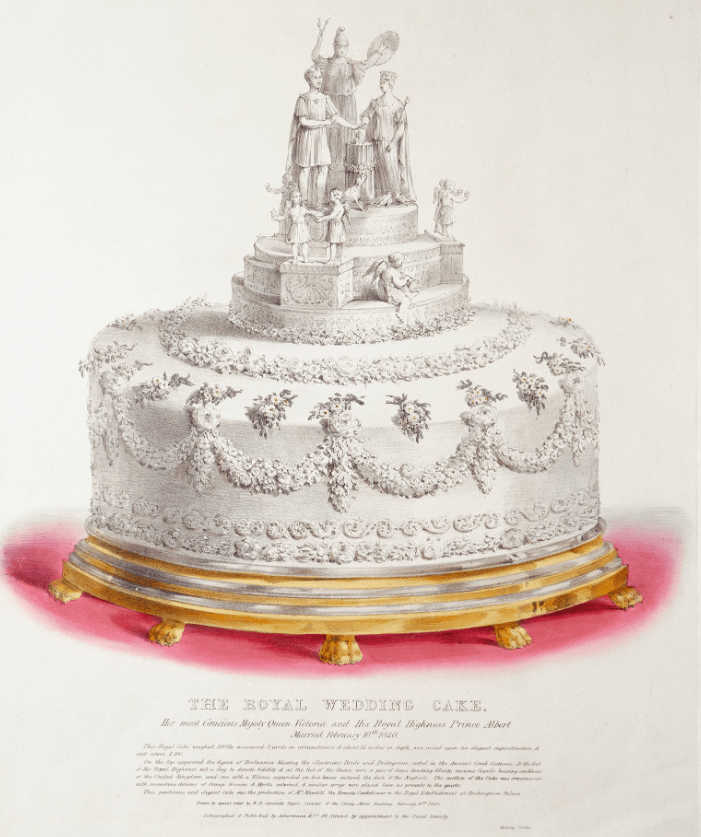
More than one wedding cake was made, to ensure there was sufficient to go around. The largest of the cakes weighed 300 lbs and had a circumference of 3 yards (9 meters). It was made by a Mr John Mauditt, who was the Yeoman Confectioner at Buckingham Palace. The description on the above lithograph reads:
“On the top appeared the figure of Britannia blessing the illustrious bride and bridegroom, vested in the ancient Greek costume. At the feet of His Royal Highness sat a dog to denote fidelity, and at the feet of the Queen were a pair of doves denoting felicity, various cupids bearing emblems of the United Kingdom, and one with a volume expanded on his knees entered the date of the nuptials. The surface of the cake was ornamented with numerous festoons of orange blossom and myrtle entwined, and similar sprigs were placed loose as presents to the guests. This ponderous and elegant cake was the production of Mr Mawditt the Yeoman Confectioner in the Royal Establishment at Buckingham Palace.”
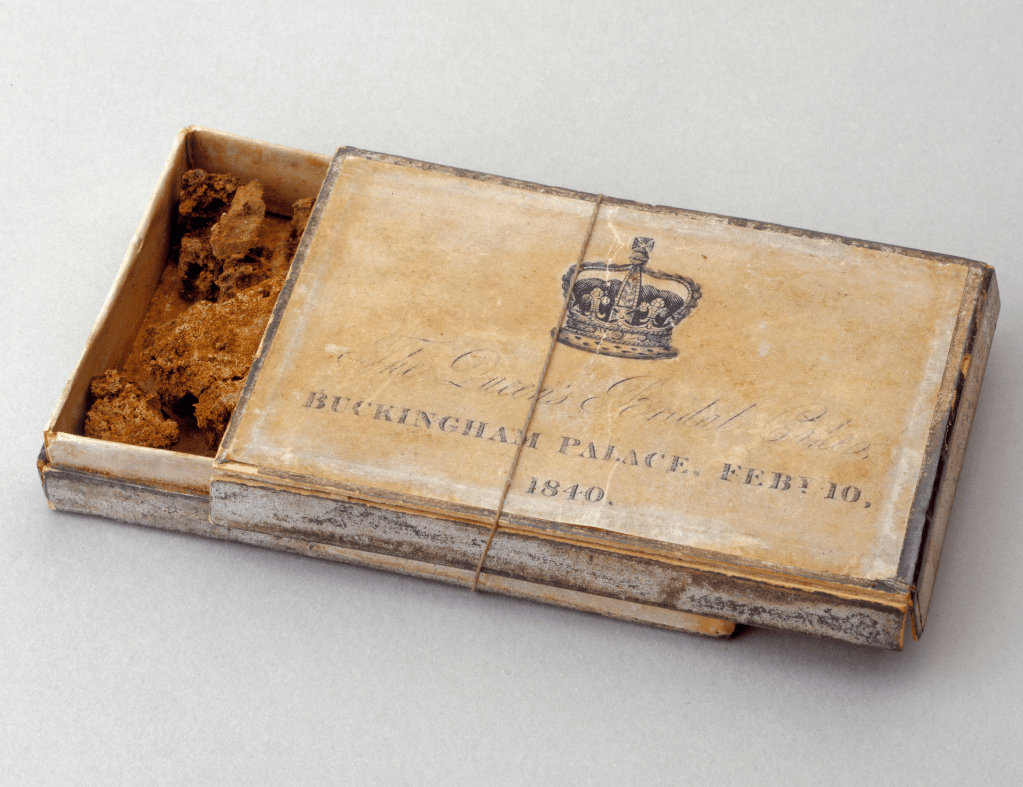
Cake was sliced up and placed into small cardboard boxes bearing the inscription ‘The Queen’s Bridal Cake’ along with the date and location of the wedding breakfast. These were distributed to those who had been involved in the preparations for the wedding, including the boys of the Chapel Royal.
The Royal Collection Trust © His Majesty King Charles III 2024
A surviving slice of the cake was auctioned off by Christie’s 2016, and made £1500.
After the breakfast was over, Victoria changed into a white silk gown trimmed with swansdown, and a bonnet trimmed with orange flowers. The bride and groom then departed to make the three hour journey to Windsor Castle, where they spent their two-day honeymoon.
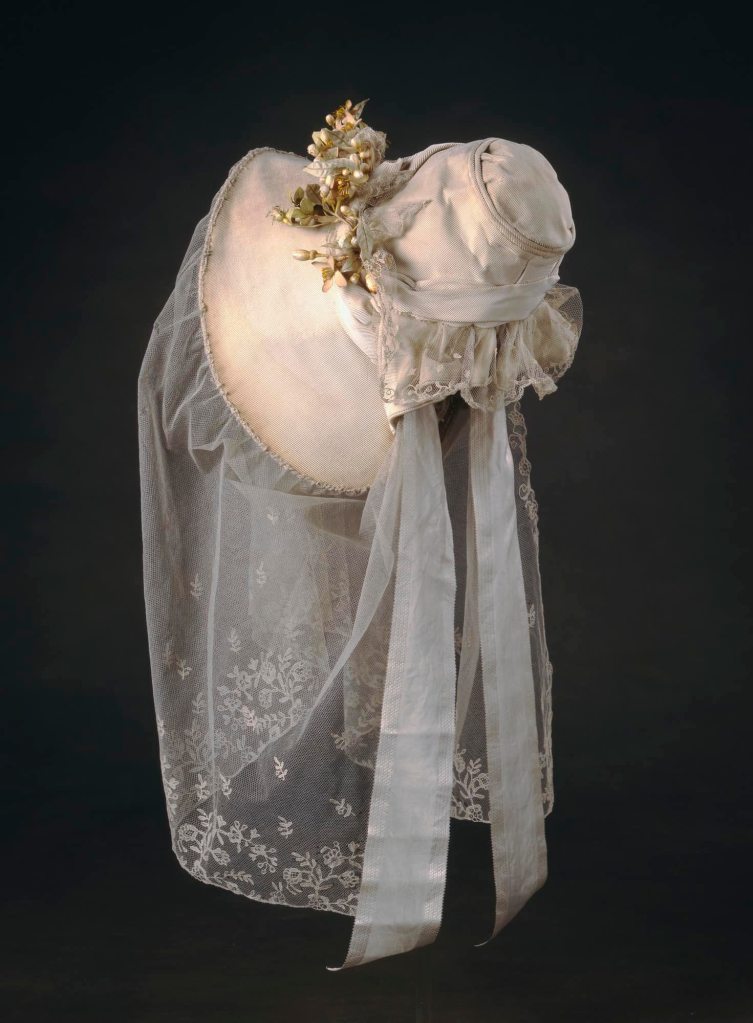
Victoria’s going away bonnet © The Royal Collection
“At ½ p.10 I went and undressed and was very sick, and at 20 m. p.10 we both went to bed; (of course in one bed), to lie by his side, and in his arms, and on his dear bosom, and be called by names of tenderness, I have never yet heard used to me before – was bliss beyond belief! Oh! this was the happiest day of my life! – May God help me to do my duty as I ought and be worthy of such blessings!”
Victoria treasured the lace flounce from her wedding dress, and continued to wear it over the years – most notably at the wedding of her daughter, Vicky, and that of the future George V. It is reported that her veil and wedding ring were buried with her in the mausoleum at Frogmore. The dress itself has been preserved and displayed several times in recent years – the lace flounce, however, is now too fragile to go on show.
If you’re interested in learning more about the details of Victoria’s wedding, in a light-hearted way, there is a programme available on BBC iPlayer, where Lucy Worsley (Curator at Historic Royal Palaces) recreates the event, bringing each detail back to life: Victoria & Albert: The Royal Wedding

 Mistress of the Robes