
On this day, twenty three years ago, the world witnessed the marriage of Willem-Alexander, Prince of Orange, to Máxima Zorreguieta, the daughter of an Argentine politician. Held in the historic Nieuwe Kerk in Amsterdam, this union bridged two distinct worlds: Dutch royalty and that of the Argentinian political elite. However, the path to their happily-ever-after was not entirely smooth.
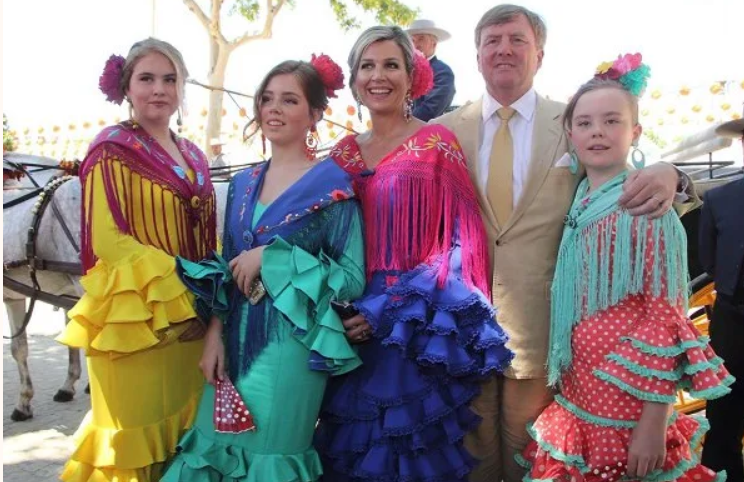
The couple first met at the Seville Fair in 1999. Willem-Alexander introduced himself only as ‘Alexander,’ and Máxima had no idea the man before her was heir to the Dutch throne. When he later revealed his identity, she thought he was joking.
Despite this initial surprise, interest was sparked, and they agreed to meet again two weeks later in New York, where Máxima worked as a Vice President for Dresdner Kleinwort Benson. As their relationship grew, she moved to Europe, taking a job at Deutsche Bank in Brussels. To avoid media scrutiny around Máxima’s nationality, her family’s history, and the royal spotlight, they kept their relationship low-key at first.
However, it wasn’t long before their relationship became public, and in 2001, Willem-Alexander announced his intention to marry Máxima. He proposed while ice skating on a frozen pond at the Huis ten Bosch royal estate. With hidden champagne and red roses in tow, he popped the question in English to ensure she understood; her “yes” was immediate.

Shared on the Koninklijkhuis Instagram account by the King: Over twenty years later, same place. Enjoying the ice! – WA
The marriage of the Prince of Orange is considered a state matter, and Willem-Alexander needed formal approval from the States-General of the Netherlands (the legislature) before marriage in order to remain in the line of succession. Two years later, his brother, Prince Friso, lost his place in the succession because he married without this ‘Act of Consent’.
Máxima’s family background created complications. Her father, Jorge Zorreguieta, had served as Secretary of Agriculture during Argentina’s brutal dictatorship under General Videla, a period known as the Dirty War—during which thousands of civilians were abducted and murdered.
Jorge Zorreguieta denied involvement in these atrocities, and Máxima believed him. However, the States-General was not convinced by mere denials and appointed a Dutch professor of Latin American studies to investigate his involvement. Although the professor concluded that Máxima’s father had not directly participated in the crimes, he suggested that, given his high-ranking position, it was unlikely he was unaware of them. The approval for the marriage was granted, but with the condition that Jorge Zorreguieta would not attend the wedding. In solidarity, Máxima’s mother, María, also chose to stay away.
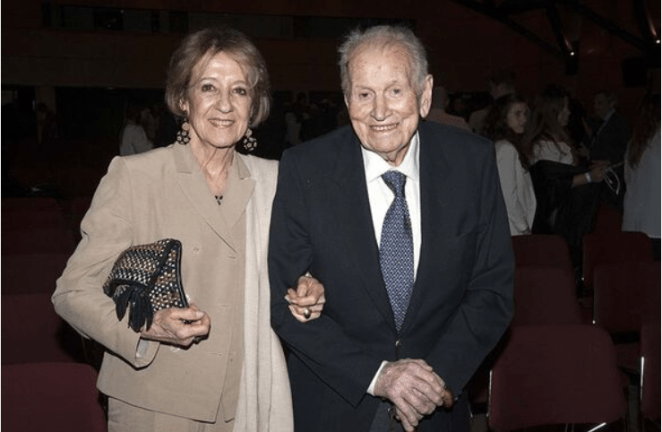
Maxima’s parents: Jorge Zorreguieta and his wife María del Carmen Cerruti Carricar
Despite the controversy, Máxima quickly won the Dutch public over with her charm and eloquence. During interviews, she impressed viewers with her fluency in Dutch, and, at the time of the wedding, her popularity was so great that one prominent republican remarked that Máxima had set the republican movement back 20 years
The wedding took place on Saturday, 2nd February, 2002, with Máxima ‘s parents watching the ceremony on TV in London. There was a civil wedding first (as required by Dutch law), performed by the mayor of Amsterdam, in front friends, family, Dutch dignitaries, and six hundred invited guests. For Willem-Alexander, his brother Prince Constantijn and two close friends acted as witnesses. Máxima’s witnesses included her new mother-in-law, Queen Beatrix, and her aunt, Marcela Cerruti Carricart.
There followed a religious ceremony, held at the Nieuwe Kerk, Amsterdam, with a guest list full of European royalty, diplomatic figures, and celebrities.
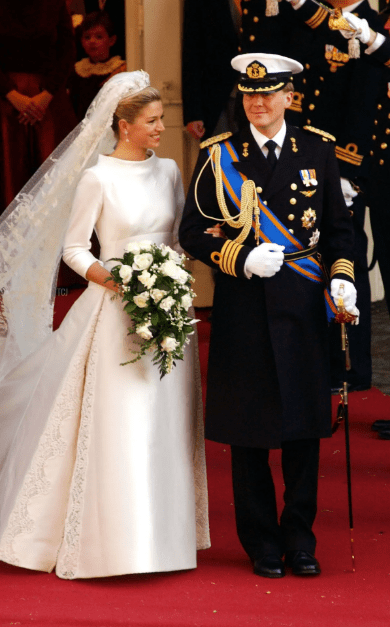
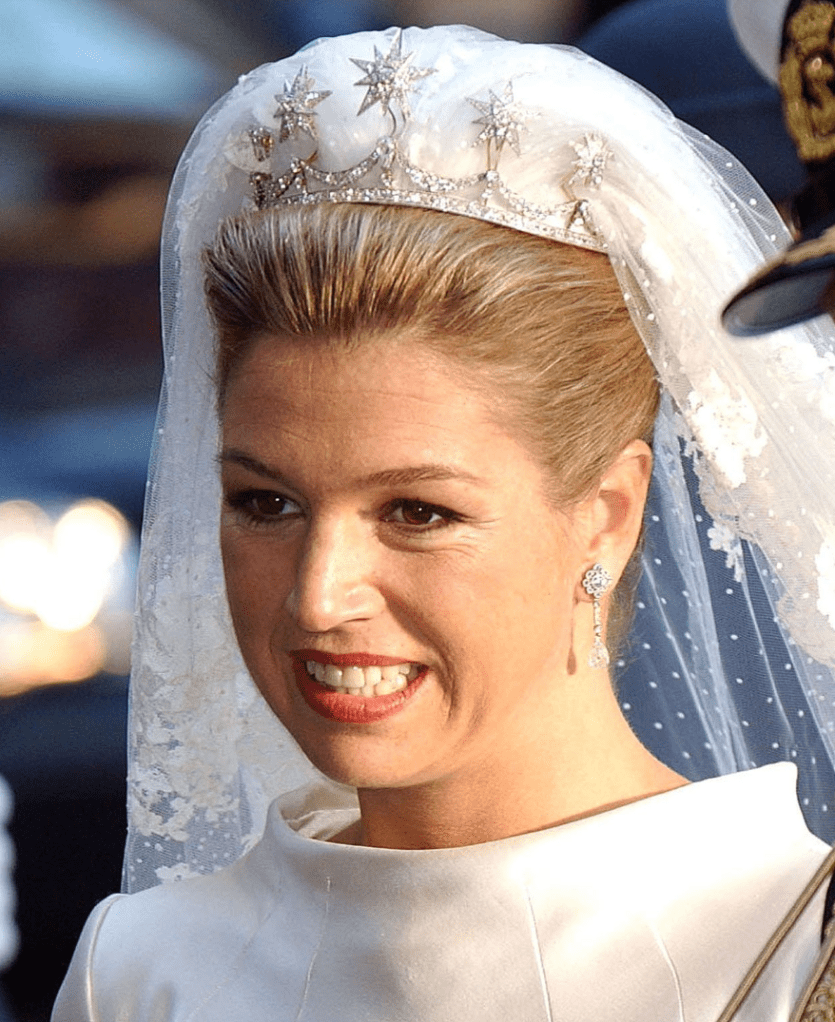
Máxima wore a beautiful Valentino gown made of ivory Mikado silk, featuring a cowl neckline and three-quarter sleeves. The dress had a dramatic five-metre-long train, and the skirt, which gently flared from the empire waist, was decorated with panels of embroidered lace along the sides. Her veil, crafted from silk tulle, and hand-embroidered with delicate flower and tendril motifs, was held in place by her tiara—a reworked version of the Dutch Pearl Button Tiara. The court jeweller had transformed it, replacing the original pearl buttons with five sparkling diamond stars, once owned by Queen Emma. Máxima carried a cascading bouquet of white roses, gardenias, and lilies of the valley, completing her timeless bridal look.
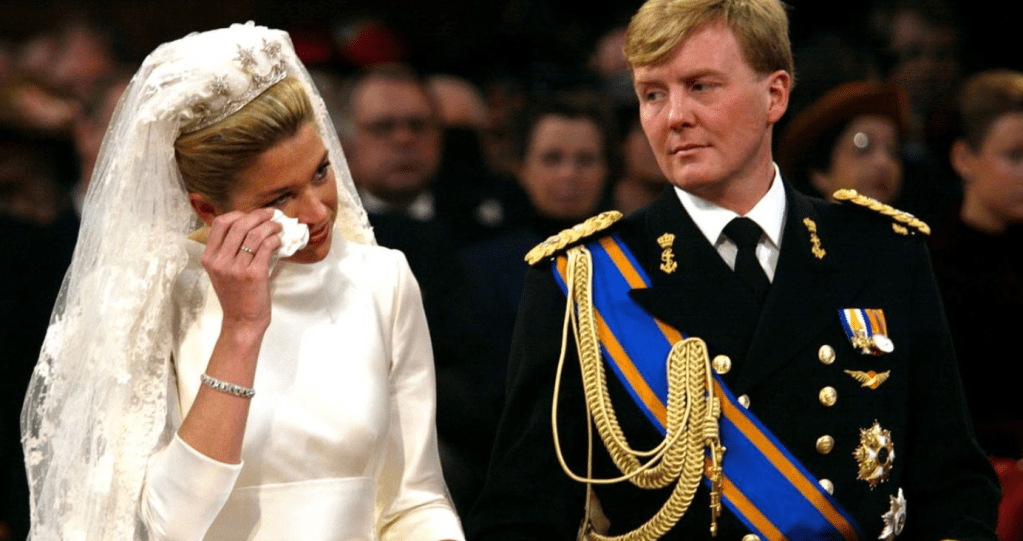
During the ceremony, Adiós Nonino, an Argentine tango by Ástor Piazzolla was played as tribute to the bride’s heritage and to her parents, whose absence she clearly felt. She was visibly emotional at this point, wiping tears away while the music played.
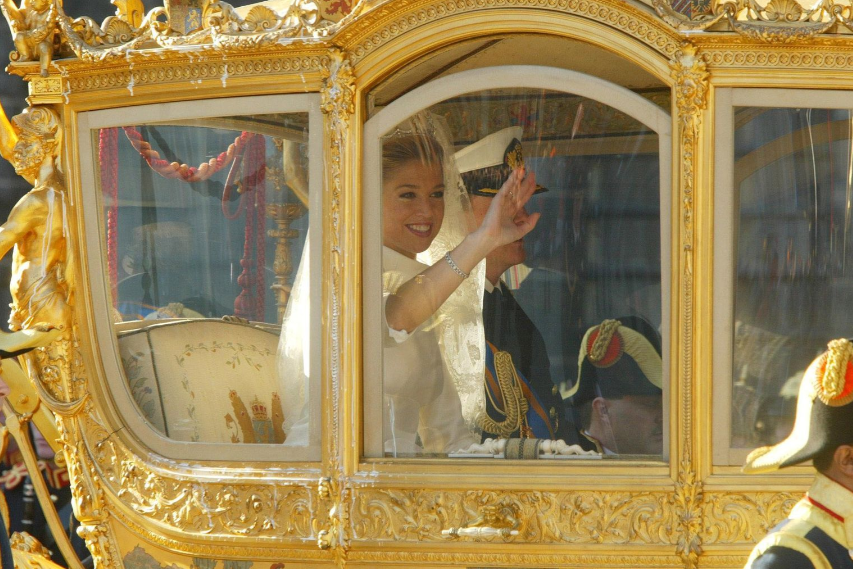
After the ceremony, the newlyweds travelled through the streets of Amsterdam in the iconic Golden Coach, with thousands of well-wishers lining the route.
The coach, gifted to Queen Wilhelmina by the people of Amsterdam to mark her coronation in 1898, was also a point of controversy. The carriage, known as De Gouden Koets, has imagery to one side depicting kneeling slaves handing over produce to their masters – including a white woman on a throne, representing the Netherlands. On their journey back from the ceremony, protestors were seen to throw eggs at the carriage in protest at its symbolism. The coach has subsequently been retired by the King and now resides in a museum.
Further protests took place on Koningsplein, when around one hundred people demonstrated, carrying signs that read: “Where is my son?” These were in memory of the thousands who disappeared during the ‘Dirty War’.
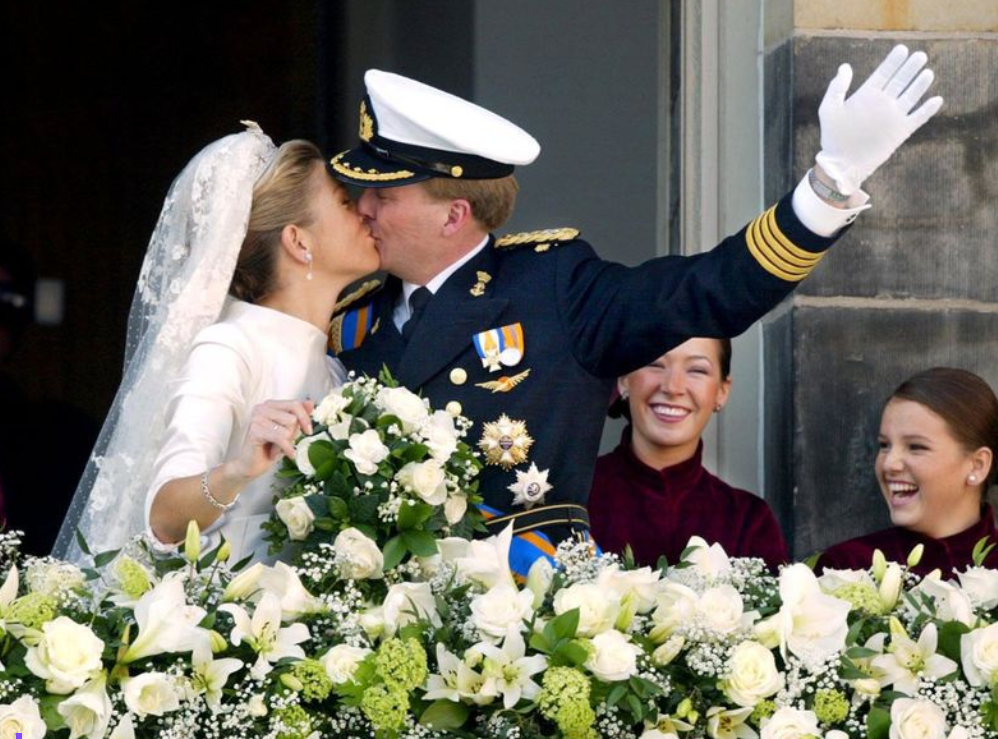
Once they arrived at the Royal Palace, the couple made their way onto the balcony above Dam Square, which was garlanded in white flowers to mark the occasion. Accompanied by the bridal party, they waved to the waiting crowds below, then shared the traditional kiss, to the delight and cheers of their audience.
Following the wedding, the Dutch people took Máxima to their hearts. A modern royal who uses her platform to champion issues like financial inclusion, and attends events such as Dutch Pride, she consistently polls as the most popular member of the Dutch royal house.
The couple have three daughters, Catharina-Amalia, The Princess of Orange, Princess Ariane, and Princess Alexia, and in 2022 they made the journey back to the Seville Fair to mark their 20th anniversary, and to share with their children where it all began.