27th January is International Holocaust Remembrance day, a date chosen to commemorate the liberation of Auschwitz-Birkenau concentration camp.
On this day, we remember the systematic murder of 6 million Jews, and, this year, to mark the 80th anniversary of the liberation, King Charles III will attend commemoration events in Poland, alongside other European Heads of State. There is, perhaps, a personal element in this day for Charles, as his Grandmother was instrumental in saving a Jewish family from Nazi persecution.
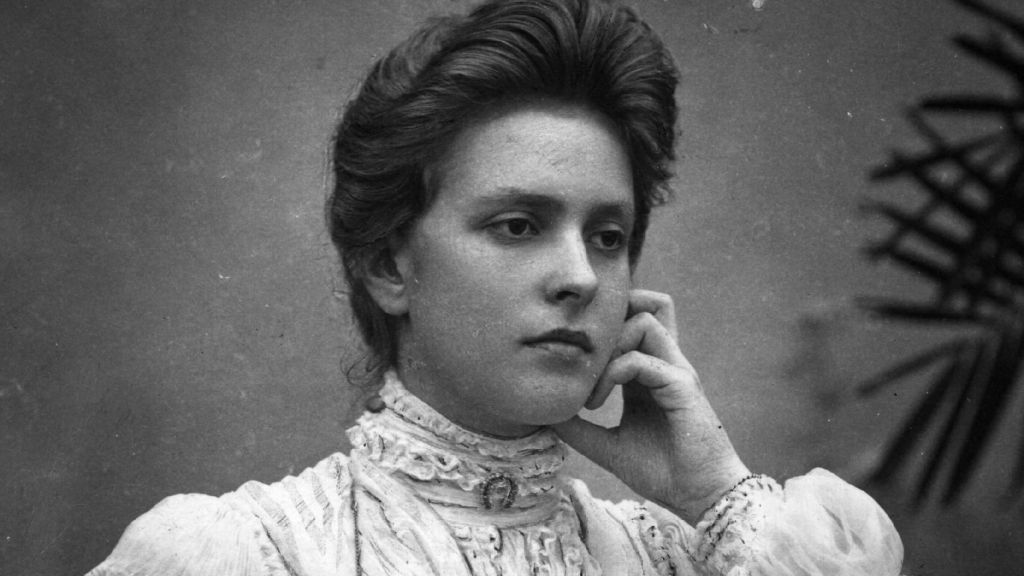
Her Serene Highness, Princess Alice of Battenberg, was not a typical princess by anyone’s measure. And whilst her early life was that to be expected of a German princess, and great granddaughter of Queen Victoria, it certainly did not progress that way.
She was born in the tapestry room at Windsor Castle, with Queen Victoria in attendance. Christened Victoria Alice Elizabeth Julia Marie, she was the eldest child of Princess Victoria of Hesse and by Rhine and Prince Louis of Battenberg. Among her six godparents was her maternal aunt, Grand Duchess Elisabeth Feodorovna of Russia, who came to be a source of great inspiration to Alice in later years.
Diagnosed deaf at an early age, Alice didn’t let that stop her, and she learnt to lip read and speak in both English and German – she also learnt Greek following her marriage.
Her early years were spent between Darmstadt, London, and Malta, and her family retained close ties with their royal cousins. So much so, that Alice was chosen as bridesmaid at the marriage of Prince George, Duke of York, and Princess Mary of Teck (later King George V and Queen Mary).

Wedding group photograph within decorative frame. Left to to right standing: Princess Alexandra of Edinburgh; Princess Victoria of Schleswig-Holstein, Princess Victoria Melita of Edinburgh; the Duke of York; Princess Victoria of Wales; Princess Maud of Wales. Seated: Princess Alice of Battenburg; Princess Margaret of Connaught, Princess Beatrice of Saxe-Coburg (in front); Princess Victoria Mary, Duchess of York; Princess Victoria Eugenie of Battenburg; Princess Patricia of Connaught. © His Majesty King Charles III
She also attended the coronation of King Edward VII in 1902, where she met Prince Andrew of Greece and Denmark (the fourth son of King George I of Greece). They became engaged later that year, and were married in a civil ceremony in Darmstadt on 6th October, 1903 – followed by two religious ceremonies (Greek Orthodox and Lutheran) the next day. Due to their close relations with numerous European ruling houses, their wedding was one of the largest gatherings of descendants of Queen Victoria and King Christian IX of Demark.
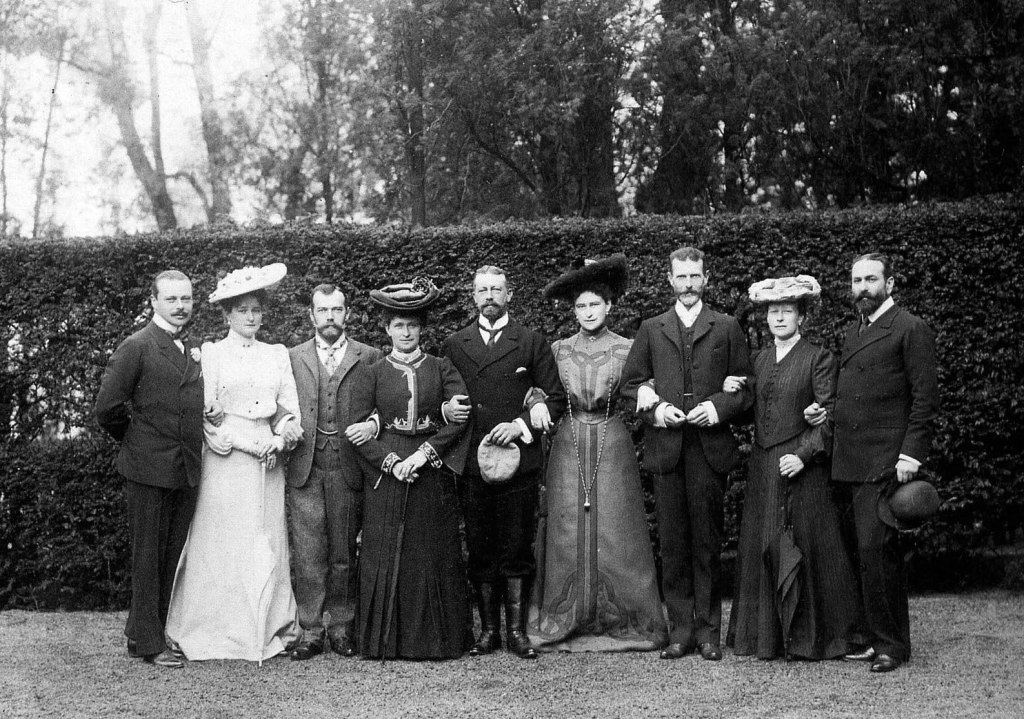
L to R: Grand Duke Ernest Louis of Hesse, Tsarina Alexandra Feodorovna and Tsar Nicholas II of Russia; Princess Irene of Hesse and Prince Henry of Prussia; Grand Duchess Elizabeth Feodorovna and Grand Duke Sergei Alexandrovich of Russia; Princess Victoria of Hesse and Prince Louis of Battenberg.
Following the marriage, she adopted the style of her husband and became known as Princess Andrew of Greece and Denmark. Prince and Princess Andrew went on to have five children: Margarita, Theodora, Cecilie, Sophie, and Philip.
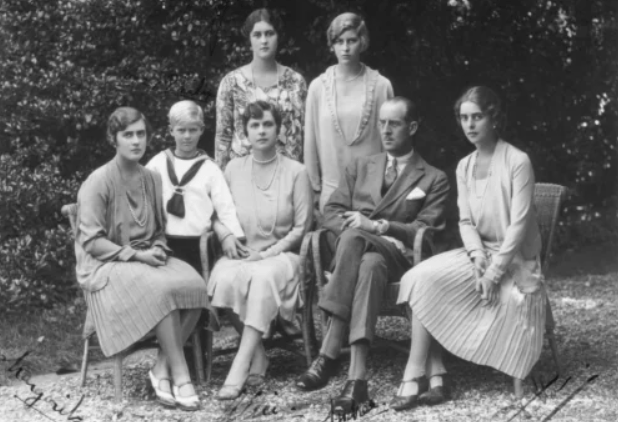
By June 1917, the Greek royal family were forced into exile in Switzerland when King Constantine abdicated. The following year Princess Alice learnt that two of her aunts, Empress Alexandra Feodorovna and Grand Duchess Elisabeth Feodorovna, had been murdered by the Bolsheviks. And as WW1 drew to a close, her uncle, Ernest Louis, Grand Duke of Hesse and by Rhine, was deposed. Her parents were also forced to reject their German royal titles by George V, and instead became the Marquess and Marchioness of Milford Haven.
The Greek royals were briefly restored in 1920, and Alice returned to live on Corfu, at Mon Repos, where Prince Philip, Duke of Edinburgh, was born.

Photograph of Mon Repos villa on Corfu with a view up chicane in driveway, between low hedges separating it from beds of shrubs and trees. A neo-classical house stands at the end with a colonnaded porch.
The reprieve was brief, however, as the king was forced into exile once again, and Prince Andrew was arrested. He was put on trial and was considered by British diplomats to be in ‘mortal danger’ as a number of those arrested at the same time were given a brief trial and then shot. Instead, Andrew was court martialled, and allowed to accept banishment from Greece in lieu of his prison sentence. George V sent a Royal Navy ship to evacuate the family, and they were forced to flee Corfu – with Prince Philip, famously, in an orange box. He was just 18 months old at the time.
They then settled on the outskirts of Paris, where Alice became active in charity work supporting Greek refugees. Also, her religious convictions deepened around this time, and in 1928 she converted to the Greek Orthodox religion. She then began to claim she was in receipt of divine messages and had been blessed with healing powers. Her behaviour was of increasing concern and she was eventually diagnosed with paranoid schizophrenia. Following this, she was forcibly interned in a Berlin sanatorium. Sigmund Freud was involved in her treatment, and suggested that the cause of her behaviour was sexual frustration – his solution was that they should repeatedly x-ray her ovaries to kill off her libido!
During this period, she and her husband became essentially estranged. Her son moved to England to live with his Battenberg (now Mountbatten) relatives, and her daughters married assorted German princes. She didn’t see her family again until the funeral of her daughter, Cecilie, in 1937. Cecilie, along with her husband and children, had perished in an air crash in Ostend. Princess Alice saw her husband at the funeral for the first time in six years.
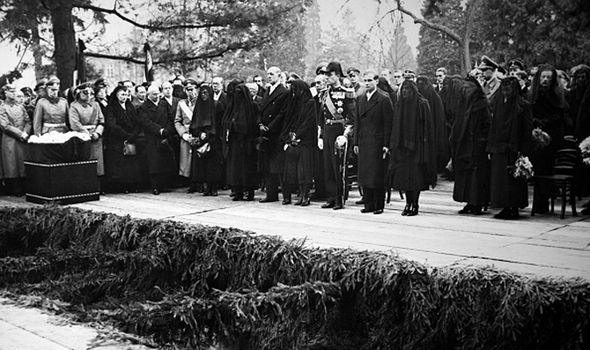
Funeral of Princess Cecilie, Grand Duchess of Hesse and by Rhine, in Darmstadt.
WWII divided Alice’s family, with her son serving in the Royal Navy, and her sons-in-law fighting with the Nazis. She lived in Athens for the duration, and shared a house in the centre of the city with her sister-in-law, Princess Nicholas of Greece. She threw herself into charity work again, supporting the Red Cross, arranging soup kitchens to feed the starving Greek people, and organising shelters for orphaned children. She also paid visits to her sister, Louise, now the Crown Princess of Sweden, and was able to use this opportunity to bring much-needed medical supplies back to Athens.
The German forces mistakenly assumed she was pro-German, due to her sons-in-law’s service, but she is reported as having told one German general, who asked if he could do anything for her, “You can take your troops out of my country.“
When Mussolini fell in 1943, the German army occupied Athens. 60,000 Greek jews were deported to Nazi concentration camps, with only 2000 still alive at the war’s end. It was during this time that Princess Alice took a Jewish family into her house to hide them. Rachel Cohen was the widow of former member of the Greek parliament, and had five children – four sons and one daughter. The sons planned to escape to Egypt, where the Greek government in exile were set up, but the journey was too hazardous for Rachel and her daughter, Tilde.

Left to right, Tilde Cohen, Alfred Cohen, Haimaki Cohen and Rachel Cohen in 1941. Photograph: Evy Cohen
Made aware of their plight, Princess Alice agreed to shelter them on the top floor of her house. She arranged for two trustworthy individuals to act as liaisons for them, so they could maintain contact with the outside world. It was this way that Rachel Cohen discovered one of her sons had been unable to get to Egypt and was also in need of shelter – Princess Alice took him in without question. They stayed with her until the end of the war. At times she faced suspicion from the Gestapo and was questioned, but Alice cleverly used her deafness to pretend she could not understand them – thankfully, they did not press further. She even faced a visit from her daughters with their Nazi husbands, who were equally suspicious – again, Alice played up her deafness, and reportedly told them there was a nanny living upstairs, which they accepted.
The Cohens stayed with Alice until the liberation of Athens in 1944. Harold MacMillan, who was ‘British Minister Resident in the Mediterranean’ at the time, visited Princess Alice and reported her ‘living in humble, not to say somewhat squalid conditions‘. She later acknowledged to Prince Philip that, in the last week before the liberation, she’d had no food apart from bread and butter, and no meat for several months.
In 2019, Evy Cohen, granddaughter of Rachel Cohen was quoted in an article for The Guardian, “What Princess Alice did, she saved the whole family. Clearly I wouldn’t be alive, I wouldn’t be here, I wouldn’t be born if it hadn’t been for her.”
Some time in December, she was informed that her husband, Prince Andrew, had died of heart failure. He had been in Monte Carlo at the time, having spent the war in Vichy France with his mistress, Comtesse Andrée de La Bigne. Alice had not seen her husband in five years at this point.
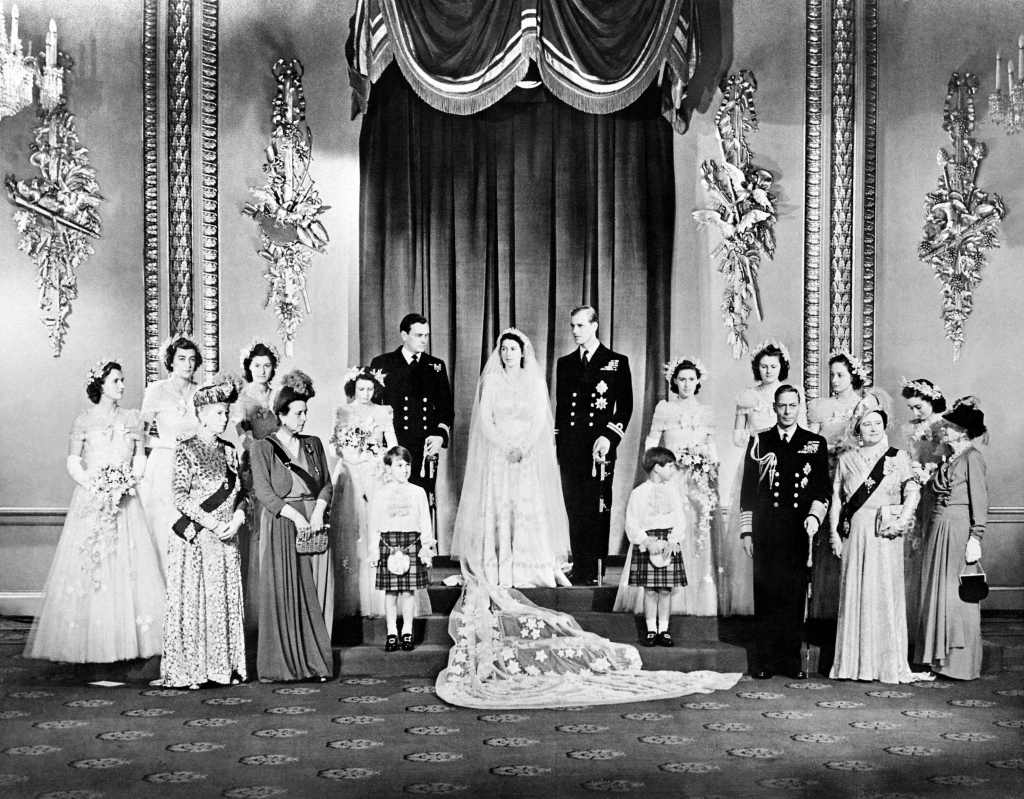
In April 1947, Alice was able to watch her son, Prince Philip, marry Princess Elizabeth at Westminster Abbey. Philip had proposed with an engagement ring containing jewels given to him by his mother from her remaining jewellery collection (most of which had been sold off by this time). Philip’s sisters were not invited – anti German feeling was still very strong at that time, and it was felt their attendance was not appropriate given their involvement with the Nazi regime.
In 1949, inspired by her aunt, Grand Duchess Elisabeth Feodorovna, Alice established the Christian Sisterhood of Martha and Mary in Athens. In 1953, she attended her daughter-in-law, Elizabeth II’s coronation dressed in an outfit designed to mimic her nun’s habit. This time her daughters were invited.

Princess Alice at the head of a procession of The Duke of Edinburgh’s family at the coronation
Despite Alice’s best efforts, her order eventually closed due to a lack of applicants. She left Greece in 1967, for what would be the last time; the Colonels’ Coup had left the country unsafe for her to remain. She was invited to stay at Buckingham Palace by her son and daughter-in-law, where she lived out the remainder of her years.
Initially buried in the Royal Crypt in St George’s Chapel at Windsor Castle, her remains were moved in 1988, in accordance with her wishes. Before her death, Princess Alice had expressed a desire to be interred at the Convent of Saint Mary Magdalene in Gethsemane on the Mount of Olives in Jerusalem, where her aunt, Grand Duchess Elisabeth Feodorovna, was also buried.
Following Alice’s death, Alfred Cohen, Rachel Cohen’s son, began the process to have her efforts honoured by the Yad Vashem Holocaust Museum in Jerusalem. In 1993 they bestowed upon her the title ‘Righteous Among the Nations’ – a title given to non-Jews who saved Jewish lives during the holocaust. The following year, her son, The Duke of Edinburgh, and her daughter, Princess George of Hanover (nee Princess Sophie of Greece & Denmark), made the trip to Yad Vashem, where they planted a tree in her honour.

Of his mother, Prince Philip said, “I suspect that it never occurred to her that her action was in any way special. She was a person with deep religious faith and she would have considered it to be a totally human action to fellow human beings in distress.”

“And so we must know these good people who helped Jews during the Holocaust. We must learn from them, and in gratitude and hope, we must remember them–” Elie Wiesel
 Mistress of the Robes