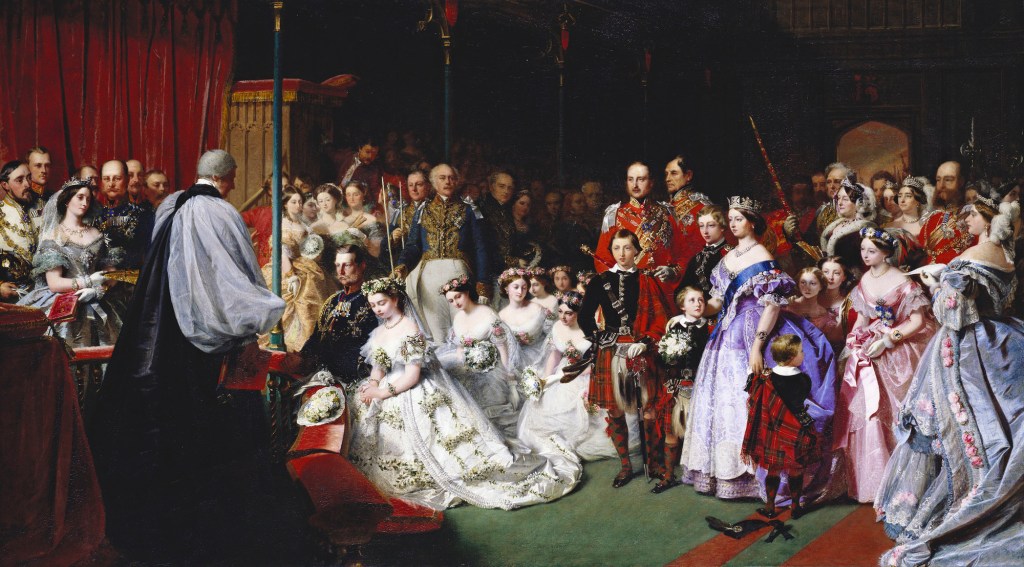
On this day in 1858, Victoria, The Princess Royal, eldest child of Queen Victoria and Prince Albert, married Prince Frederick William of Prussia in the Chapel Royal at St James’s Palace.
The couple had first met back in 1851, when Frederick, along with his parents, Prince William of Prussia, and Princess Augusta of Saxe-Weimar-Eisenach, attended the opening of the Great Exhibition — Victoria had been 10 at the time, and Frederick 19. Victoria and Albert asked their daughter to be Frederick’s guide through the exhibition. Fortunately, Vicky (as she was known) was able to converse in fluent German, because Frederick’s English was very limited. Frederick also impressed her father, Prince Albert, during his visit, and shared many of his liberal ideas.
Vicky and Frederick struck up a correspondence after this visit, but did not meet again until 1855, when he came to visit at Balmoral Castle. His purpose was to meet Vicky again to ensure she had grown into a suitable consort for him.
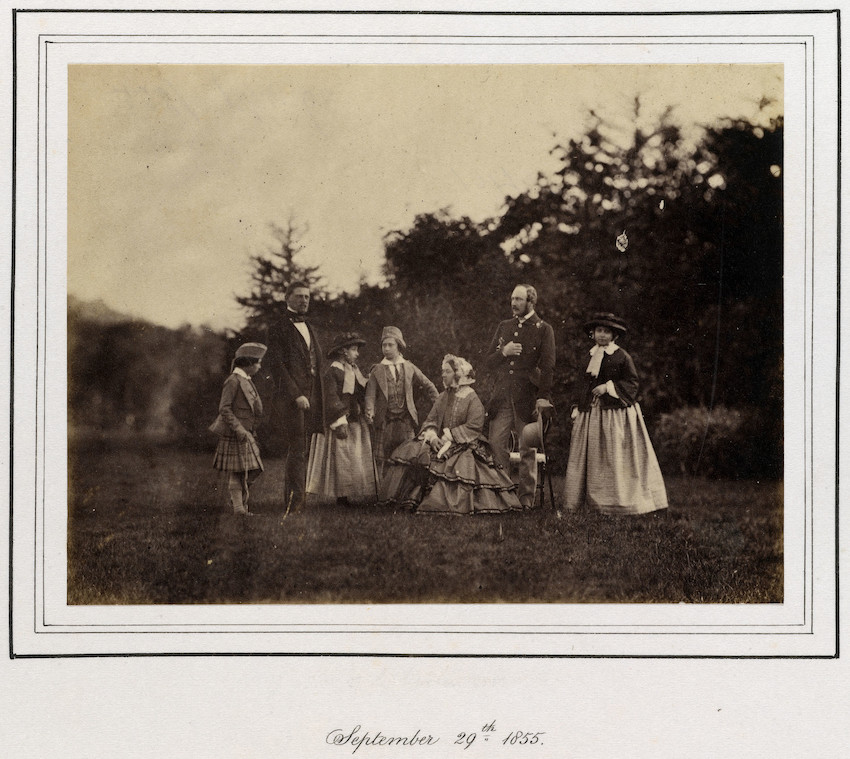
Photograph taken at Balmoral on the day Frederick proposed to Vicky. L to R: Prince Alfred, Prince Frederick William of Prussia, Princess Alice, Albert Edward, Prince of Wales, Queen Victoria, Prince Albert, Victoria, The Princess Royal. © His Majesty King Charles III
Vicky was only 14 at the time of the proposal, and Queen Victoria gave her consent on the condition that the marriage did not take place until her daughter was 17. The engagement was not formally announced until 17th May, 1856, and received mixed reactions in Germany, and even less positive ones in the UK. Parliament did, however, agree to grant Vicky a dowry of 40,000 pounds (approx 4.2 million pounds in today’s money).
At Queen Victoria’s insistence, and despite the German Emperor’s objections, the wedding was confirmed to take place in the Chapel Royal at St James’s.
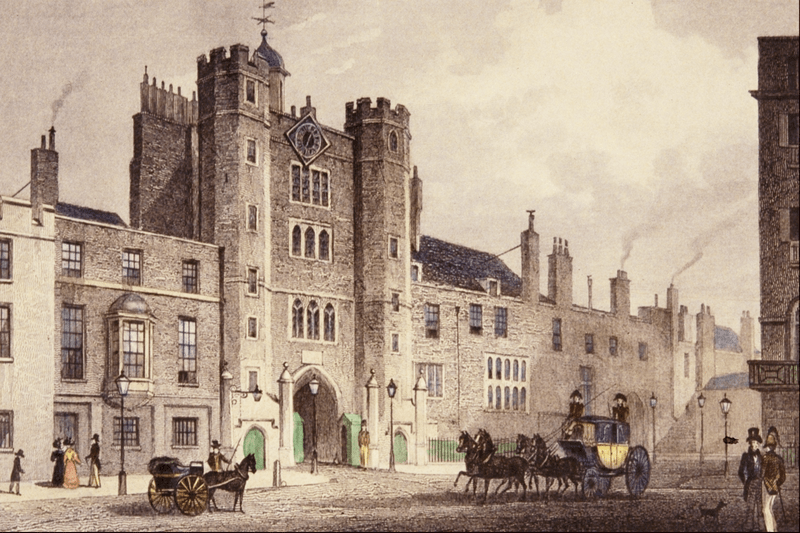
The wedding took place on 25th January, 1858, and with it began the realisation of Albert’s & Victoria’s dreams of securing the future peace in Europe through the dynastic marriages of their children.
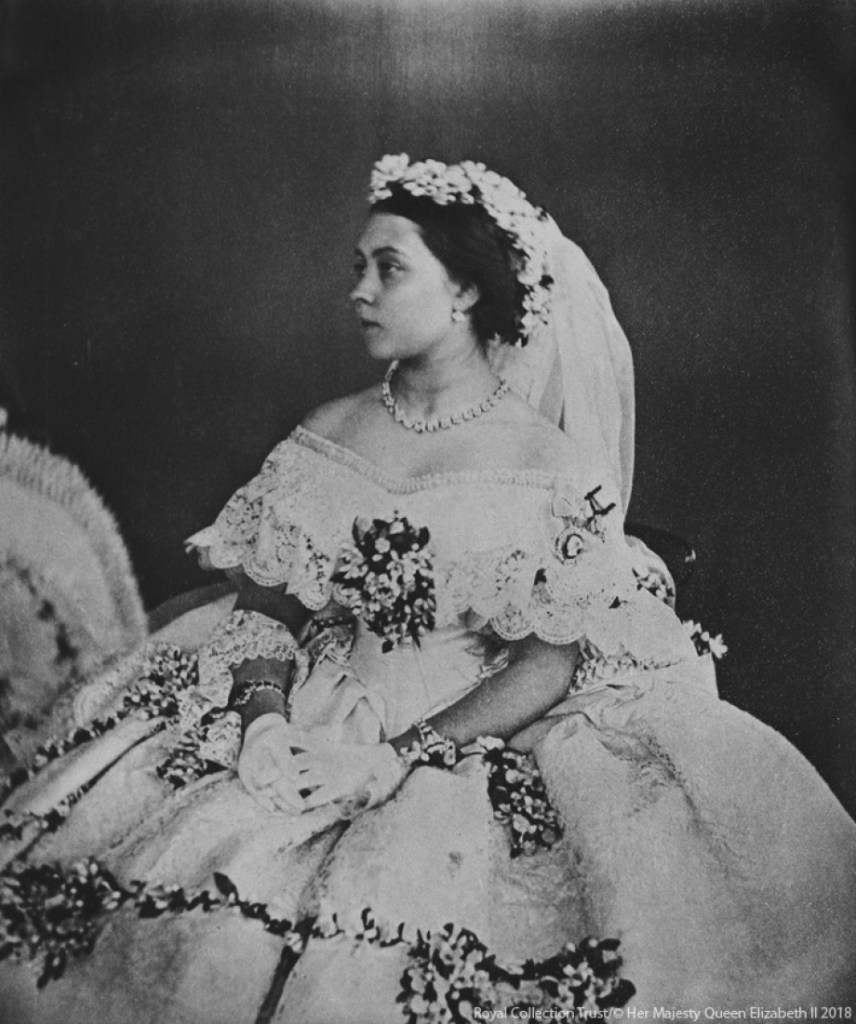
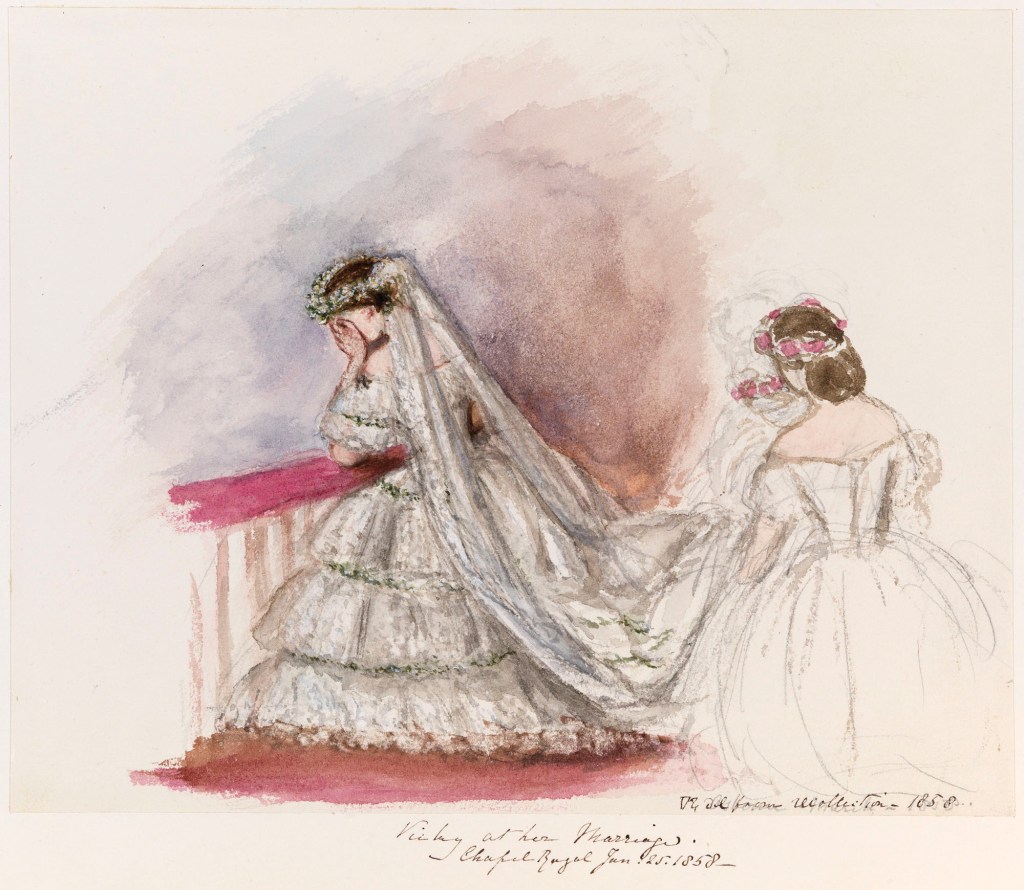
Following the trend set by her mother, almost 18 years before, the bride wore a white dress, made of moire antique, adorned with three flounces of Honiton lace (the lace was decorated with bouquets of roses, shamrocks, and thistles – to symbolise England, Ireland, and Scotland). Wreaths of orange and myrtle blossom decorated these flounces (the latter being the wedding flower of Germany), and larger bouqet of the same flowers was set in the centre of the bodice. The train was also white moire antique, trimmed with Honiton lace, and measured over three yards in length (approx. 9 foot). She also wore a diamond necklace, earrings, and brooch.
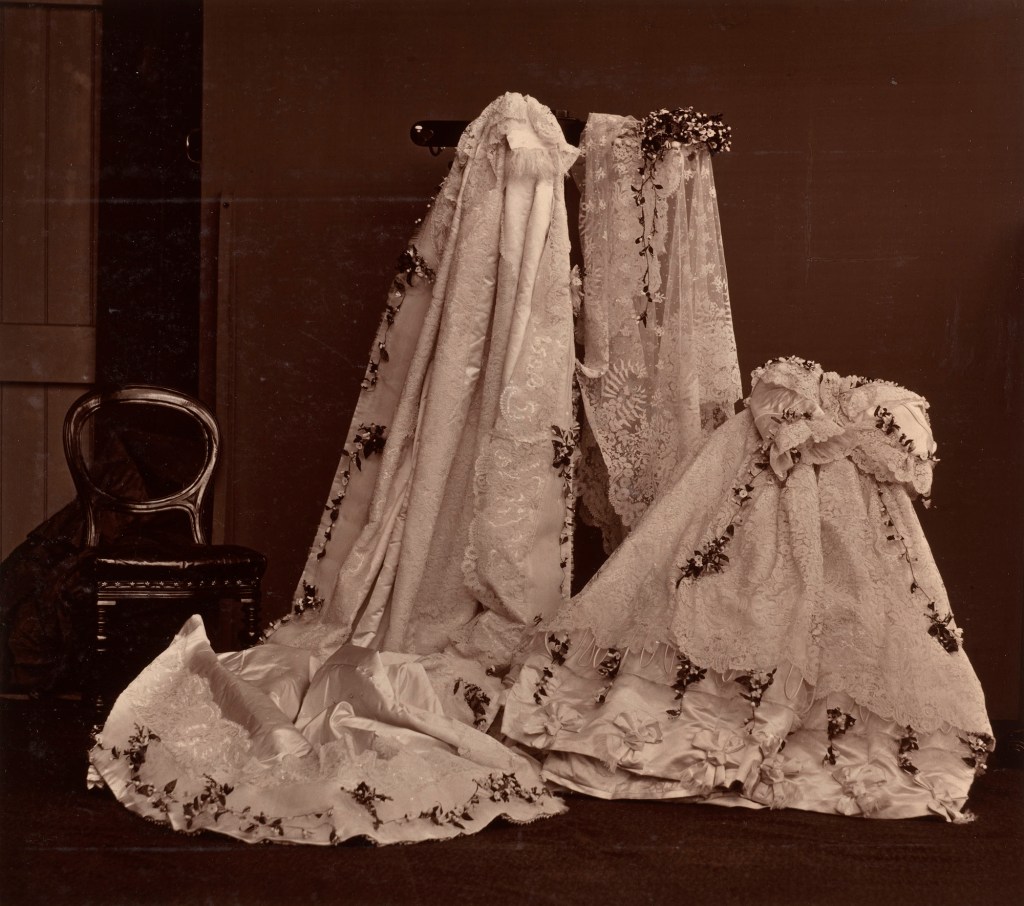
Vicky had chosen 8 bridesmaids, all the unmarried daughters of Dukes and Earls. In her diary, Queen Victoria described their outfits as ‘white tulle dresses with wreaths and bouquets of pink roses and white heather.
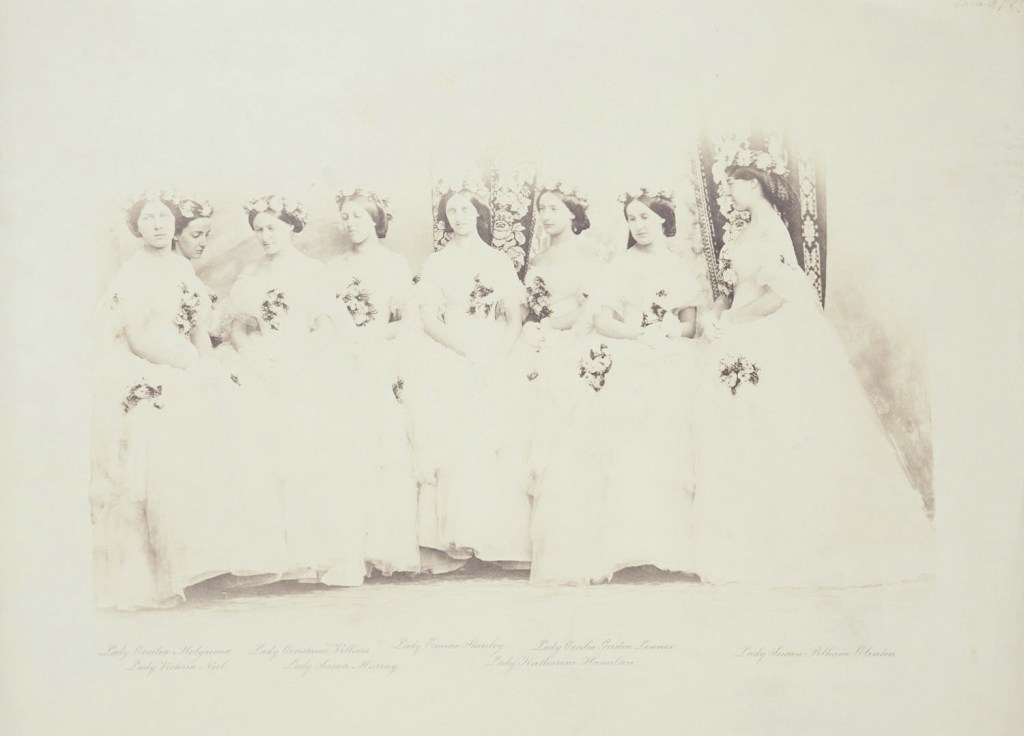
The bridesmaids were: Lady Cecilia Lennox, Lady Susan Clinton, Lady Katherine Hamilton, Lady Emma Stanley, Lady Constance Villiers, Lady Susan Murray, Lady Cecilia Molyneux, and Lady Victoria Noel. © His Majesty King Charles III
Queen Victoria also went on to describe her own outfit, and those of other family members in attendance. She was wearing a dress of ‘mauve moire antique & silver, trimmed with Honiton lace. I wore my Regal Diadem and the crown diamonds. My train was of velvet and also trimmed with lace.’
Vicky’s siblings were also in attendance with ‘the 3 girls in pink satin trimmed with Newport lace, Alice with a wreath of cornflowers & marguerites, the 2 others only with sprays of them, in their hair. The 4 boys wore highland dress‘. The baby of the family, Princess Beatrice, was less than a year old at the time, so was not in attendance at the ceremony.
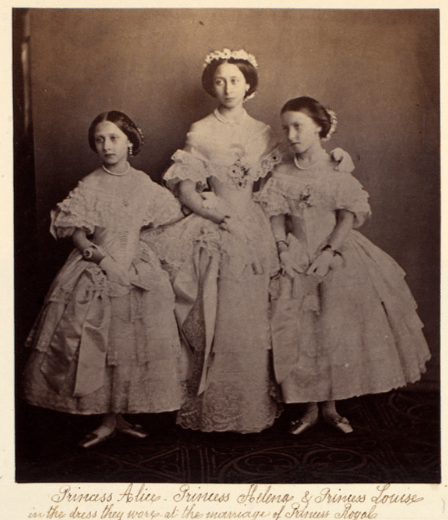
The Royal Collection ©His Majesty King Charles III
“My last fear of being overcome, vanished, when I saw Vicky’s calm and composed manner. It looked beautiful seeing her kneeling beside Fritz, their hands joined, her long train born by the 8 young ladies, who looked like a cloud of young girls hovering round her, as they knelt near her. How it reminded me of my having similarly, proudly, tenderly, confidently knelt beside my beloved Albert, in the very same spot.”
Victoria recorded the above in her diary entry for the day. She also went to paint the event.
After the ceremony, the bride and groom left the church to the strains of Mendelssohn’s Wedding March being played — it was this ceremony that popularised the use of his music in the future weddings. They then returned to Buckingham Palace, with crowds cheering the couple along the way, and made the now traditional balcony appearance, accompanied by Queen Victoria, Prince Albert, Uncle Leopold (King Leopold I of the Belgians), and the groom’s parents.
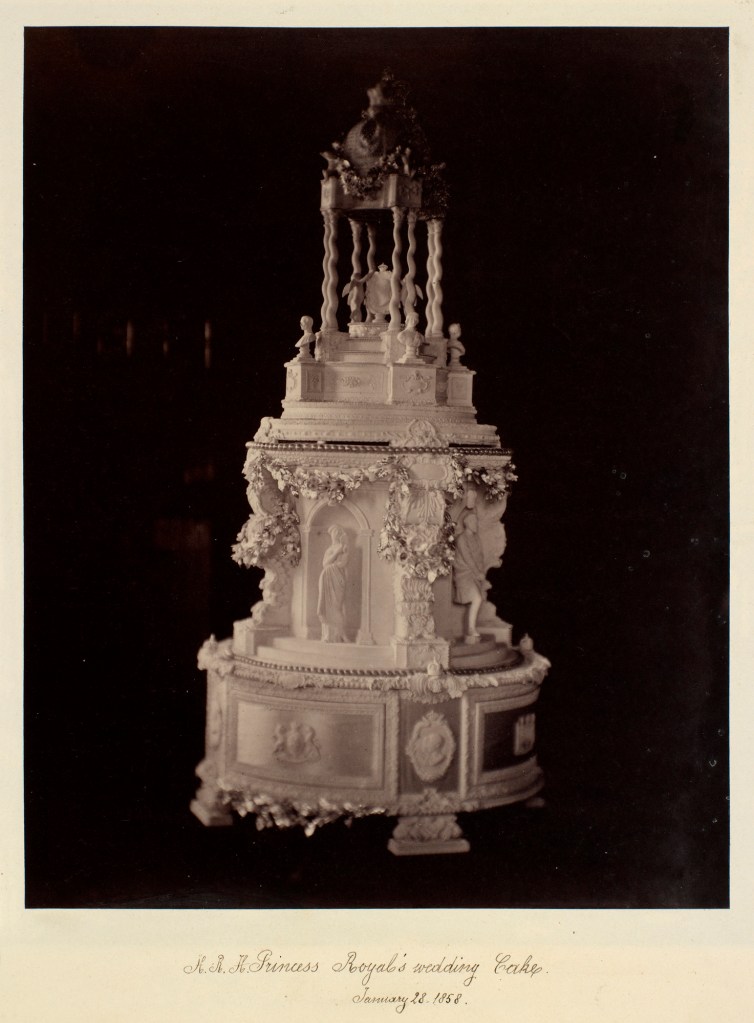
After that, they headed to the White Drawing Room for the wedding breakfast. Queen Victoria was seated between her Uncle Leopold and the Prince of Prussia (the groom’s father). She noted in her diary that: ‘The couple sat togeher, opposite us, but hid by a splendid wedding cake‘. The cake was highly ornamental and featured decorations modelled on neo-classical sculptures.
Afterwards, Vicky changed into a going away outfit of white velour épinglé, a mantel of the same fabric, trimmed with grebe, and a white bonnet with orange flowers, & fine lace veil.
Vicky and Fritz were married for 30 years, and had 8 children – among them, Kaiser Wilhelm II, and Sophie, Queen of the Hellenes. They are the ancestors of the current King of Spain, Felipe VI (via his mother, Queen Sofia), Constantine II of Greece (died 10th Jan, 2023), and Prince Ernst August of Hanover.
Frederick became emperor on 9th March, 1888, but sadly only reigned for 99 days – dying of throat cancer on 15th June, 1888 – before his son Wilhelm succeeded him. Presciently, before his death, he lamented ‘I cannot die…What would happen to Germany?’
 Mistress of the Robes